Maltese Puppy Feeding Chart: How Much to Feed by Week
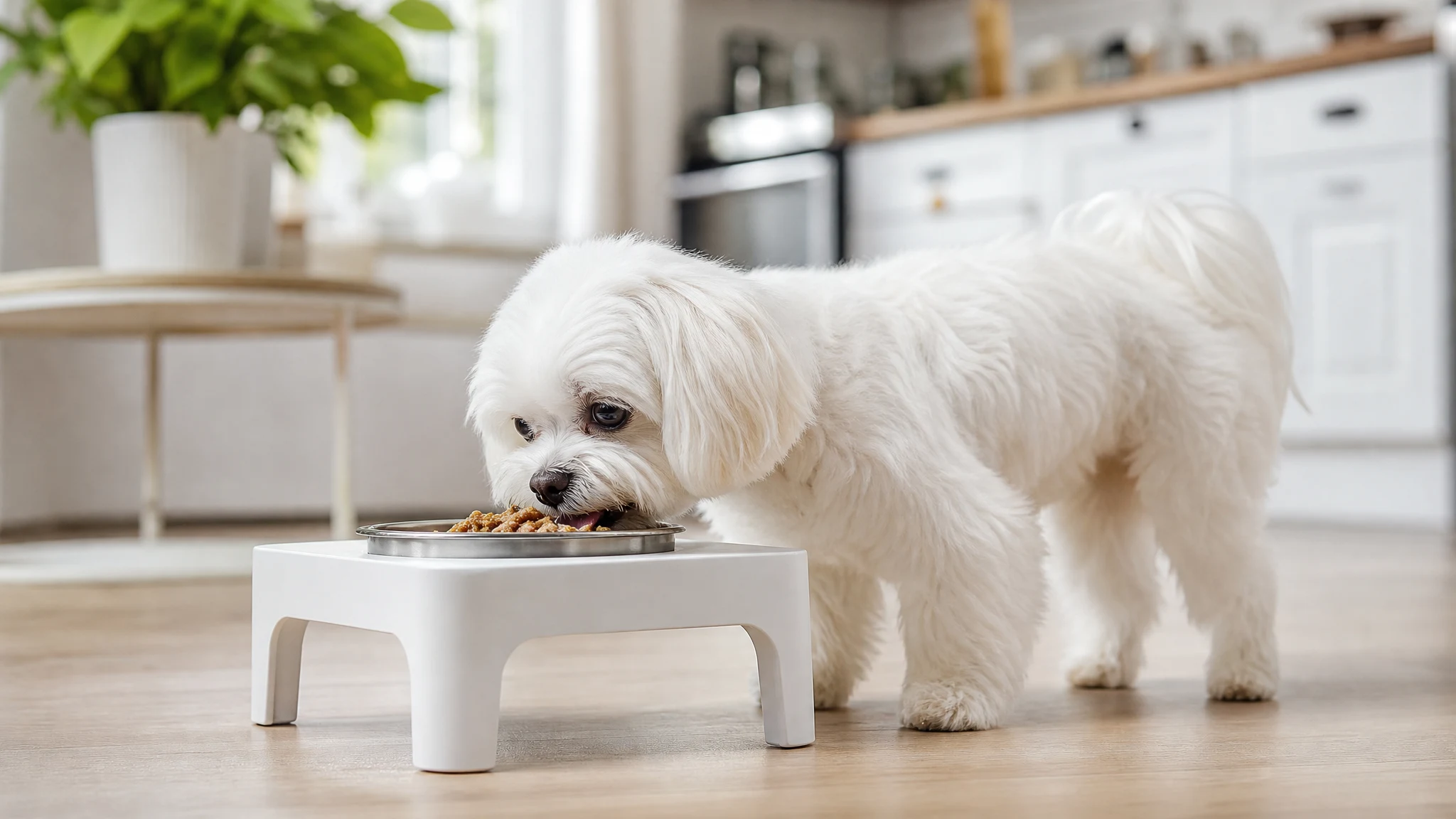
General nutrition information compiled from product labels and published sources, not veterinary advice. Your veterinarian is the right person to choose a diet for your dog, especially one with a health condition.
A Maltese puppy is tiny, and small mistakes at the bowl add up fast. Most adults weigh under 7 pounds, according to Chewy's breed guide. A few extra pieces of kibble a day is a bigger share of the diet than it would be for a larger dog.
This guide shows you how to build a dog feeding chart for your own puppy. You will use the label guide on the food you chose, your puppy's current weight, and a steady routine. One honest note first: no trustworthy chart gives one cup amount for every Maltese at every week. Brands publish their own guides, and puppies differ. So this page teaches the method, not a single magic table.
What you need before you start
- A complete and balanced puppy food, or an all life stages food, chosen with your veterinarian.
- The feeding guide from the brand's own page or the bag.
- A kitchen scale for the puppy (a small pet scale or a bathroom scale you weigh yourself on, then with the puppy).
- A measuring cup, or a gram scale for the food.
- A notebook or phone note to record weight, meals, and treats.
- A small, shallow bowl and a quiet feeding spot.
Step 1: Pick a food made for a growing puppy
Look for the AAFCO statement on the label. For a puppy, it should say the food is complete and balanced for growth, or for all life stages. Chewy's breed guide says the Maltese generally does well on commercial food that meets AAFCO standards for its life stage, and it mentions small-breed formulas.
You do not need a large-breed puppy food. AAFCO treats large-breed puppies as those expected to reach 70 pounds or more as adults, according to Whole Dog Journal. A Maltese is far below that. Foods labeled for all life stages "except growth of large size dogs" are therefore a fine match for the clause that matters here.
Step 2: Weigh your puppy
Most feeding guides work by body weight, not by week. Weigh your puppy on the same scale, at about the same time of day. Write down the number.
Weekly weighing in the early months gives you a trend. If the number climbs steadily, that is a useful sign. If it stalls or drops, call your veterinarian rather than adjusting on your own.
Step 3: Find the label guide for your puppy's weight
Open the brand's feeding guide and find the row that matches your puppy's current weight and age. Here is what the brand pages we compared actually say. We compared label data only. We did not run feeding trials or taste tests.
| Food | What the brand's guide says | Calories per cup or can |
|---|---|---|
| VICTOR Hi-Pro Plus Small & Medium Breed Puppy (dry) | Puppies 6 to 11 weeks: a 2 lb puppy is listed at 0.70 cups per day | 383 kcal per cup |
| Royal Canin Size Health Nutrition Small Puppy (dry) | Feeding chart is an image on the page, and the page points to a feeding calculator | 349 kcal ME per cup (as fed, calculated) |
| Hill's Science Diet Puppy Small & Mini Beef & Barley Entrée (wet) | Cans per day listed by dog weight and age range | 223 kcal per 5.8 oz can |
Notice that the calories differ between foods. That is why cup amounts cannot be swapped from one brand to another. Use the guide for the food in your bowl.
One caution on size. The Royal Canin Small Puppy formula is built for dogs expected to weigh 9 to 22 pounds as adults, which is bigger than a typical Maltese. A formula for small puppies can still suit a Maltese, but your veterinarian can help you judge portions for a very small dog.
Step 4: Split the daily amount into regular meals
The label gives a total for the day. Divide it into meals you can repeat every day. Chewy's breed guide lists hypoglycemia (low blood sugar) as a Maltese health issue and says regular meal timing can help prevent it. That is a reason to keep the schedule steady, not a promise that any routine prevents it.
Ask your veterinarian how many meals a day suit your puppy's age and size. Do not skip meals to "catch up" later. Call your vet right away if your puppy seems weak, shaky, or unusually sleepy.
Step 5: Build your own weekly chart
Make a small table with these columns:
- Week of age
- Weight that week
- Daily amount from the label guide
- Meal times
- Treats given
- Notes (appetite, stools, energy)
Each week, weigh your puppy and look up the label row again. Update the daily amount. Rewriting it weekly keeps the chart tied to your actual puppy. It also leaves a record you can show your veterinarian at checkups.
For a broader age and weight overview, see our guide to how much to feed a Maltese by age and weight.
Step 6: Count treats and keep them small
Chewy's breed guide says treats should not exceed 10% of daily calories. For a toy dog, that is a very small number of calories. Break training treats into crumbs. If your puppy eats a lot of treats on a training day, trim the meals a little, within what the label guide and your vet allow.
Step 7: Plan the move to adult food
Royal Canin's Maltese Adult formula is listed for Maltese 10 months and older. Its guide lists daily cups by activity level. For a 4.4 lb (2 kg) dog, that is 1/2 cup at low and medium activity and 5/8 cup at high activity. Those numbers are for adult dogs, so they are not a puppy chart.
The exact age a Maltese counts as an adult was not something we could confirm from an official source. Ask your veterinarian when to switch. When you do, mix the new food in gradually over several days, as the brand's own instructions suggest.
Common mistakes to avoid
- Using a guide for the wrong food. A cup of one food is not a cup of another.
- Eyeballing the cup. A heaped scoop can be much more than a level one for a tiny dog. Level the cup or weigh the food.
- Forgetting treats and chews. They count toward the day.
- Free feeding. Leaving food out all day makes it hard to see how much your puppy actually eats.
- Changing food suddenly. A fast switch can upset a small stomach.
- Chasing a trend. The FDA says it has not identified a specific dietary cause in its canine dilated cardiomyopathy (DCM) investigation. Its page describes the link between diet and DCM as complex and the investigation as ongoing. Talk to your veterinarian rather than choosing a food on fear alone.
Tips that make the chart easier
- Weigh food in grams if you can. It is more exact than a cup.
- Take the guide's number as a starting point, not a rule.
- Keep a short note on stools and appetite. Changes are worth mentioning to your vet.
- Use the same bowl and place each meal so mealtime becomes a calm routine.
- Chewy's breed guide lists luxating patella as a Maltese health issue and says a healthy weight can help. Steady, measured feeding supports that goal.
What results to expect
If you measure carefully and adjust weekly, you may see steady weight gain, regular stools, and an energetic puppy that finishes meals with interest. Results vary from one puppy to the next. A chart cannot promise a particular outcome, and food does not treat or prevent any condition.
The American Maltese Association says the breed is relatively healthy when bought from a reputable breeder. Good feeding habits are one part of that picture, along with regular veterinary care.
When to check with your veterinarian
Confirm amounts with your veterinarian if your puppy has any health condition, such as a suspected liver problem, trouble with low blood sugar, or breathing concerns. Chewy's breed guide lists portosystemic shunt and tracheal collapse as Maltese health issues. Any diet change for a dog with a diagnosed condition is the veterinarian's call. Prescription diets are only something a veterinarian prescribes.
Also call your vet if your puppy refuses food, vomits repeatedly, or loses weight.