Best Training Treats for Maltese (and How Many to Give)
General nutrition information compiled from product labels and published sources, not veterinary advice. Your veterinarian is the right person to choose a diet for your dog, especially one with a health condition.
A Maltese is a small dog. The Chewy breed guide lists adults at under 7 pounds. That changes how you pick and count training treats. A few careless handfuls can cover a surprising share of a day's calories for a dog this size.
This guide shows you how to choose the best treats for a Maltese, cut them to the right size, and keep the total in check. It compares categories, not brands. We did not feed, taste or test any treats ourselves.
What You Need
- Two or three treat types. Soft training treats, freeze-dried single-protein pieces, and plain vegetable pieces cover most needs.
- Your dog's regular food label. You need its calories per cup to do the math below.
- A small cutting board and a knife. Most treats need cutting down for a toy dog.
- A treat pouch or small container. It keeps the day's allowance in one place.
- A kitchen scale or measuring spoons (optional). They help you portion the day's treats in the morning.
- A harness. The Chewy breed guide lists tracheal collapse as a Maltese health issue and recommends a harness over a collar. A harness is the better choice for leash practice.
Step 1: Know the Limit Before You Open the Bag
The Chewy breed guide says treats should not exceed 10% of daily calories. That is the number to build your plan around. The other 90% should come from a complete and balanced main diet.
To use it, find your dog's daily calorie target on the food's label or ask your veterinarian. Then take one tenth of it. That is the ceiling for all treats in a day, including chews, dental snacks and bits of food shared from your plate.
Treat packages often list calories per treat. If the bag does not, check the brand's own website or contact the brand. Do not guess. For a Maltese, a gap of a few calories matters more than it would for a larger dog.
If your Maltese is overweight, underweight or has a medical condition, ask your veterinarian what the daily calorie target and treat allowance should be. A veterinarian decides that for an individual dog.
Step 2: Pick a Treat Category
Each category below has strengths and trade-offs. Read the label on any treat you consider. Look for the ingredient list, the calories per treat and a clear statement of what the product is.
Soft training treats
These are easy to tear into tiny pieces. They are strong rewards for most dogs, which suits early lessons and distracting places. The trade-off is that they can be calorie-dense, and some contain several ingredients you may not want. Check the label for the calories per piece and tear each piece smaller than you think you need to.
Freeze-dried single-protein treats
These list one animal protein, such as chicken or beef, as the main ingredient. A short ingredient list is easy to read. That makes them helpful if your veterinarian has asked you to keep ingredients simple. They are often crumbly or brittle, so you may need to break them with your fingers. Some are quite rich, so calories per piece still matter.
Vegetable pieces
Some dogs will work for small bits of plain vegetables. They can be a lower-calorie way to fill out a training session. Not every dog likes them, and not every vegetable suits every dog. Ask your veterinarian which ones are appropriate before you start. Serve them plain and cut small.
Step 3: Cut Treats Down to Maltese Size
Aim for pieces about the size of a lentil or a small pea, or smaller. Your Maltese does not need a bite to feel rewarded. The reward is the taste and the attention.
- Break or cut each treat into the smallest pieces your dog still notices.
- Keep the pieces soft or easy to swallow so training stays quick.
- Count the pieces you cut before the session, so you know how many calories you have prepared.
Small pieces also let you reward often without going over the limit. A dog that earns twenty tiny rewards is usually happier than one that earns two big ones.
Step 4: Count Treats Against the Day's Food
Use this simple routine each morning:
- Write down the daily calorie target from the food label or your veterinarian.
- Divide it by ten. That is the most the day's treats should add up to.
- Look up the calories in one piece of each treat you plan to use.
- Set aside the pieces you plan to use in a small container. When the container is empty, treats are done for the day.
If you had a heavy training day, give slightly less of the regular meal, as your veterinarian advises. Do not add treats on top of full meals every day. Over time that adds weight.
Weight matters for this breed. The Chewy breed guide lists luxating patella as a Maltese health issue and says keeping a healthy weight can help. Counting treats is one practical way to protect that.
Step 5: Keep Meals on Schedule
The Chewy breed guide lists hypoglycemia, or low blood sugar, as a Maltese health issue. It says regular meal timing can help prevent it. Treats should not replace a meal, and training should not push a meal back.
If your dog seems weak, wobbly or unusually sleepy, treats are not the answer. Call your veterinarian.
For more on the main diet, see our comparison of dog foods compared by label data. It explains how to read calories and guaranteed analysis, which helps you balance the whole day.
Step 6: Train With Rewards, Not Pressure
Reward-based training is the approach supported by the American Veterinary Society of Animal Behavior (AVSAB). It works like this:
- Mark the moment. Say a short word like "yes" the instant your dog does the right thing.
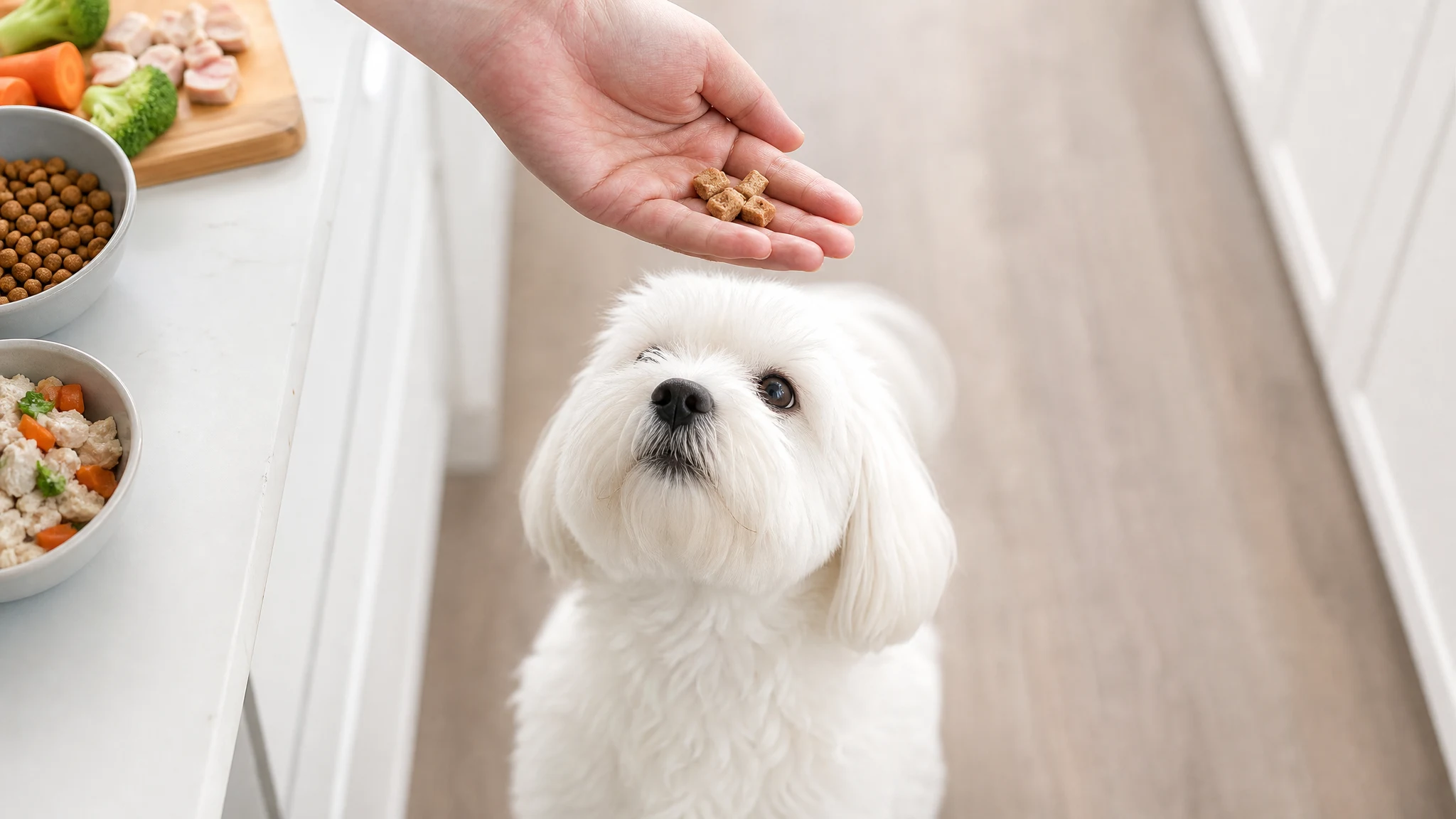
- Deliver the treat right away. Hand it low, close to your dog's mouth, so a tiny dog does not have to jump.
- Keep sessions short. Two to five minutes is plenty for most small dogs. End while your dog is still interested.
- Fade treats slowly. Once a skill is solid, reward most repeats with praise or play, and keep treats for the best attempts.
Never use force, scolding or physical corrections. They do not teach what to do, and they can damage trust.
Tips for Better Sessions
- Match the treat to the job. Use the highest-value treat for hard tasks like coming when called outdoors. Use a plainer treat for easy tasks at home.
- Rotate types. Switching between soft treats and freeze-dried pieces keeps interest up without raising the count.
- Use part of the meal. Some Maltese will work for their own kibble. Measure it out of the daily portion and the treat math gets easier.
- Introduce new treats one at a time. If your dog has an upset stomach, you will know the cause.
- Store treats sealed. Follow the package directions for storage and freshness.
Common Mistakes to Avoid
- Using full-size treats. Pieces made for bigger dogs can be several times what a Maltese needs.
- Not counting chews and dental snacks. They count toward the 10% too.
- Trusting marketing words. Terms like "natural" or "premium" tell you little. Read the ingredient list and calorie statement.
- Treating "grain-free" as a health label. The FDA says it has not identified a specific dietary cause in its investigation of diets and canine dilated cardiomyopathy, and calls the link complex. Its last update was dated December 23, 2022. Ask your veterinarian before changing your dog's diet over this.
- Feeding treats from the table. Human foods can be rich, salty or unsafe. Ask your veterinarian what is acceptable.
- Giving treats without a reason. Free treats weaken their value for training and add calories.
- Relying on treats to fix a health issue. No treat prevents or treats a disease. Health questions belong with your veterinarian.
What Results to Expect
With short, regular sessions, many Maltese start responding to simple cues within days to a few weeks. Results depend on your dog's age, temperament, past experience and the setting. Some dogs learn quickly and others need more repetition. Distractions, excitement and stubborn streaks are normal in toy breeds.
Counting treats may also help you keep your dog at a comfortable weight, though weight depends on the whole diet and activity. Your veterinarian can tell you whether your dog's weight is on track.
The American Maltese Association, the AKC parent club, says the breed is relatively healthy when bought from a reputable breeder. Healthy habits, including sensible treat use, support that but cannot promise any outcome.
Quick Reference
| Treat type | Strength | Watch for |
|---|---|---|
| Soft training treats | Easy to tear into tiny pieces | Calories per piece; longer ingredient lists |
| Freeze-dried single protein | Short ingredient list | Brittle pieces; rich, so calories still count |
| Vegetable pieces | Can be a lighter option | Not every dog likes them; ask your veterinarian which are suitable |
How We Approached This Guide
This guide compares treat categories and the label information you can check yourself. We did not run feeding trials or taste tests. For any specific treat, read the package, check the brand's own website and ask your veterinarian.
Sources
- Chewy breed guide for the Maltese (adult weight, health issues, meal timing, treat limit)
- American Maltese Association, Health Information
- FDA Center for Veterinary Medicine, DCM investigation page